

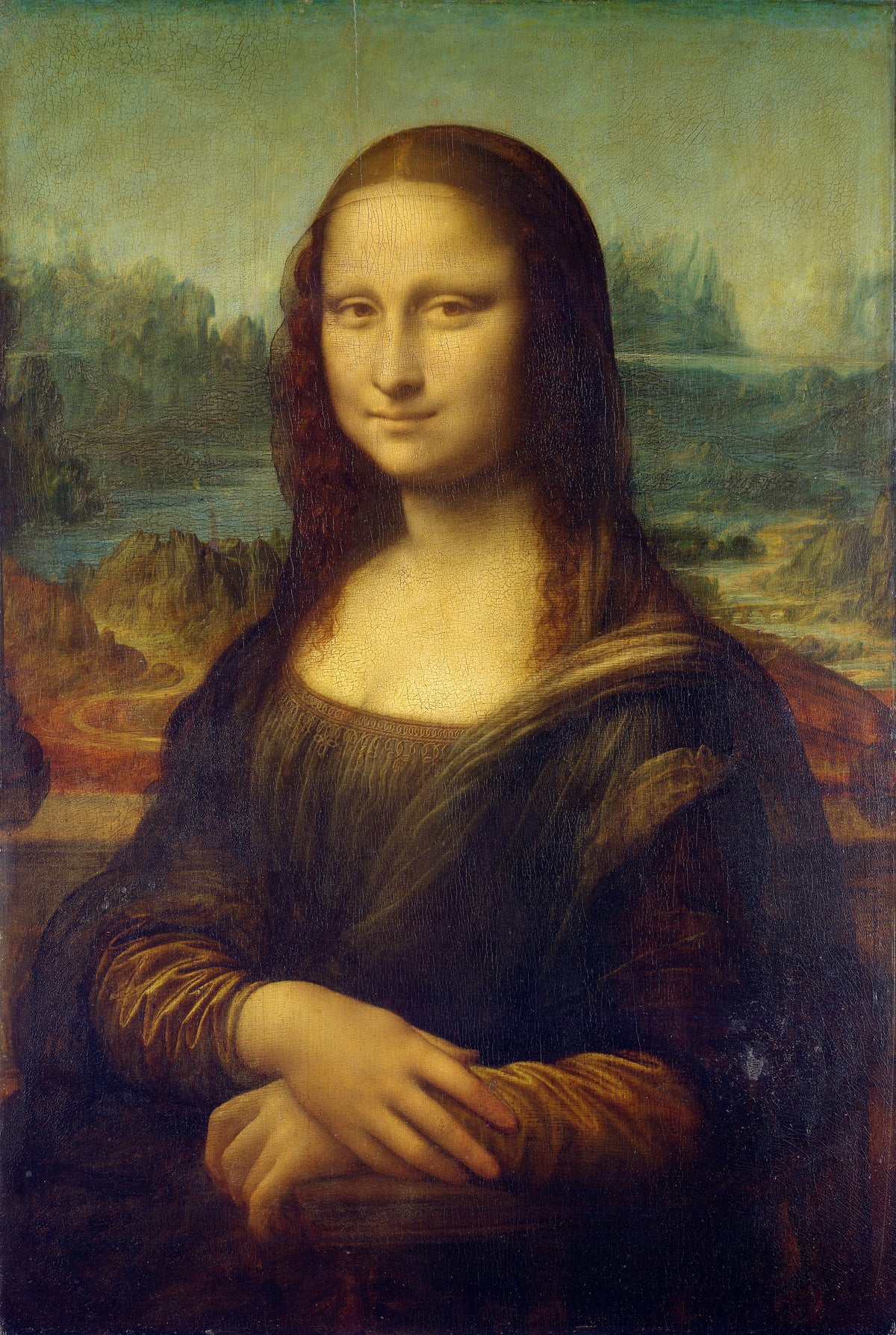
Mona Lisa, Leonardo da Vinci, about 1503–1519
For nearly four centuries the Mona Lisa was simply one respected Renaissance portrait among many in the Louvre's collection, admired by specialists, unknown to the wider public. What made it the single most famous painting on earth wasn't Leonardo. It was a theft.
On the morning of the 21st of August, 1911, an Italian handyman named Vincenzo Peruggia, who had briefly worked at the Louvre building protective glass cases, walked in wearing a museum worker's white smock, waited in a storage closet until the building emptied, lifted the panel off the wall, and walked out the next morning hidden beneath his clothes. Because it was the museum's regular weekly closure day, nobody noticed the painting was gone for more than 24 hours, until an artist named Louis Béroud arrived to paint the gallery and complained that his subject was missing.
The investigation ran for two years and famously went nowhere useful, at one point bringing detectives to question a young Pablo Picasso as a suspect. Peruggia kept the painting hidden in a false-bottomed trunk in his Paris apartment, then in Florence, until he tried to sell it to an Italian art dealer in 1913 and was arrested. He claimed he'd acted out of patriotic duty, to return an Italian masterpiece to Italy. He served seven months in prison.
The theft, and the two years of global press coverage searching for the painting, are what turned a well-regarded portrait into a cultural fixation. It has never really stopped being one since.
Corinthian's wallet is set from a public-domain photograph of the painting.
Source: Musée du Louvre, Paris; image via Wikimedia Commons, public domain.

