

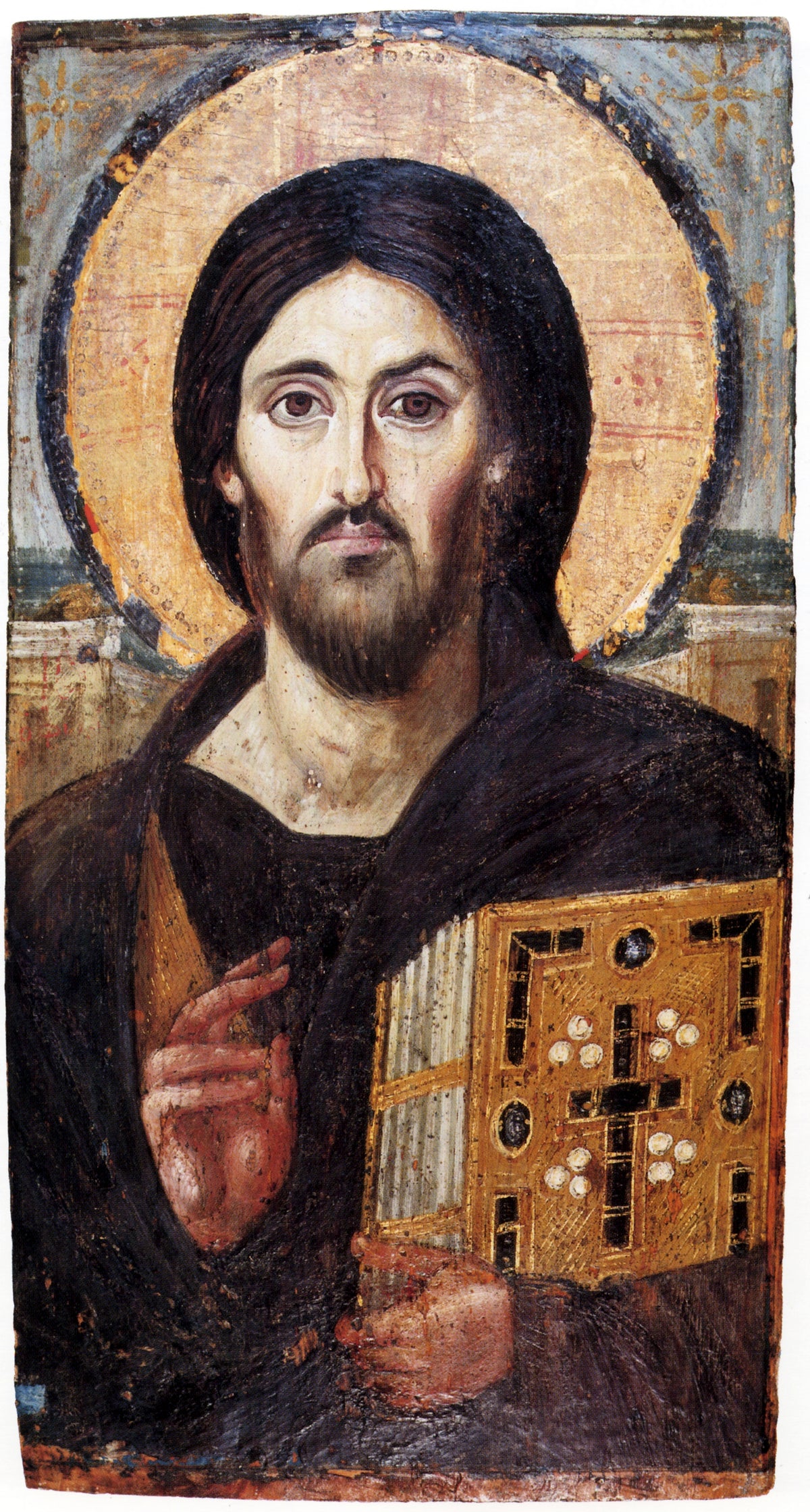
Christ Pantocrator, Saint Catherine's Monastery, 6th century
This is the oldest surviving icon of Christ Pantocrator, and it only survives because of where it ended up. It was painted in the sixth century in encaustic, pigment mixed into hot beeswax and worked onto a wooden panel, a Greco-Roman technique that all but disappeared from Christian art after this period. The panel has been at Saint Catherine's Monastery at the foot of Mount Sinai ever since.
In the eighth and ninth centuries the Byzantine empire tore itself apart over whether religious images were idolatry, and imperial officials destroyed icons across its territory. Sinai was by then under Muslim rule and outside the reach of those orders, so the monastery's earliest panels were simply left alone. Almost nothing else of this age exists anywhere.
The face is the part people keep returning to. The two halves are painted differently. Cover one side and Christ looks calm and human, cover the other and the expression hardens, the eye widening and the brow dropping. Whether that asymmetry was deliberate theology about the dual nature of Christ or simply how the painter worked is still argued over, but it is what gives the icon its unsettling directness.
For centuries the panel sat under layers of later overpainting, and the sixth century surface underneath was only uncovered when the icon was cleaned in the twentieth century.
Source: Saint Catherine's Monastery, Mount Sinai.

