
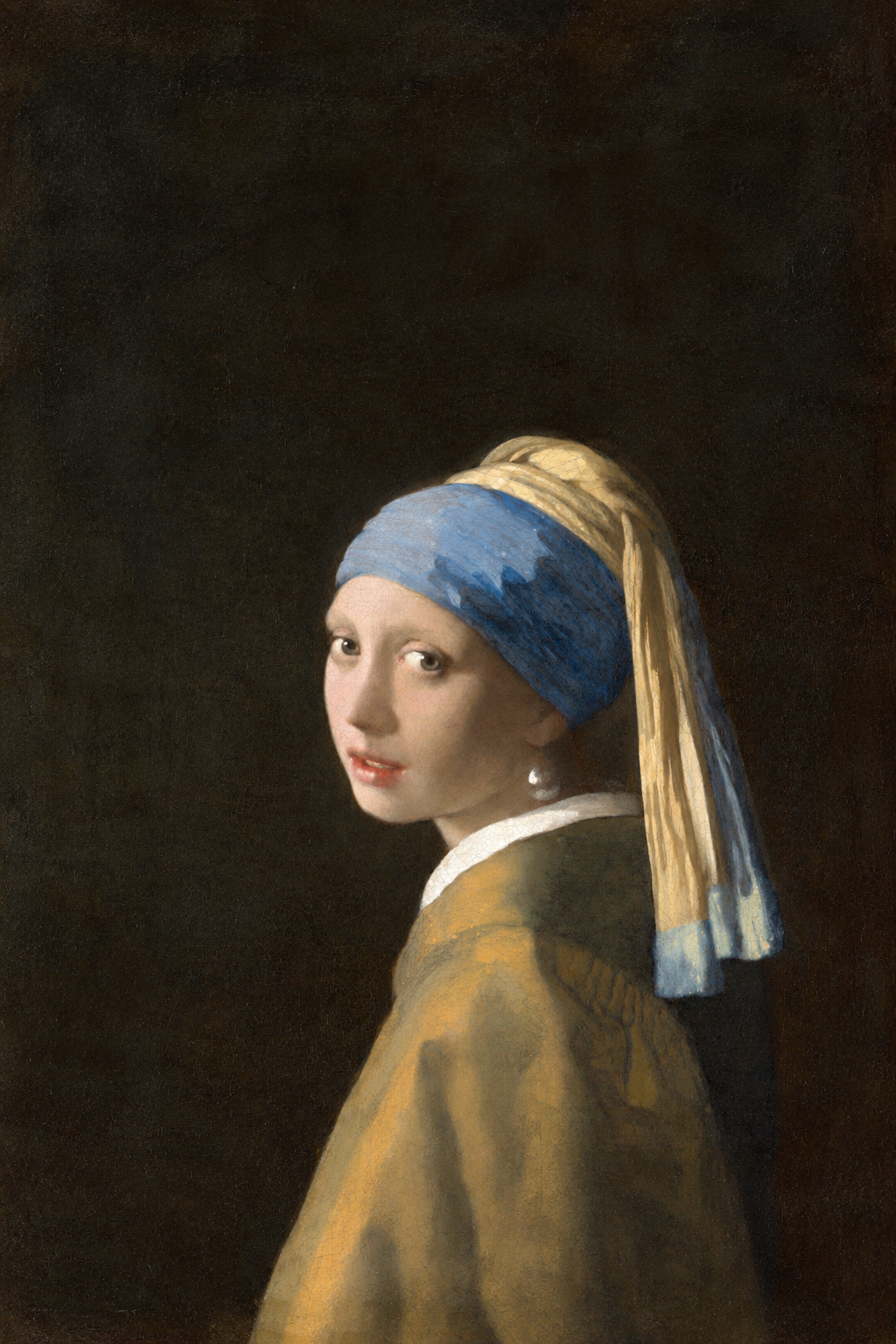
Girl with a Pearl Earring, Johannes Vermeer, about 1665
It is not, technically, a portrait. The Mauritshuis in The Hague, which has held the painting since 1902, classifies it as a tronie, a Dutch genre from Vermeer's own century built around a type or character rather than a documented sitter. Theories have floated a name, most often Vermeer's eldest daughter Maria, but the museum itself is direct about it: nobody knows who she was, or whether she was a real person at all.
The earring that gives the painting its title is an illusion built from two brushstrokes and a single dab of white paint for the highlight. There is no hook rendered connecting it to her ear. It isn't clear the pearl, as such, exists as an object at all, only as an effect of light Vermeer chose to paint.
A 1994 restoration stripped away centuries of yellowed varnish and revealed the subtlety of the colour underneath, and a more recent technical study by the museum's own conservation team, using scanning and imaging technology unavailable in the 1990s, found faint eyelashes and confirmed the background, now a flat black, was originally a deep green curtain that has simply faded with time.
The painting's modern fame is recent. It spent most of its history as a respected but unremarkable Dutch picture until a 1999 novel by Tracy Chevalier imagining the story behind it, followed by a 2003 film, turned it into one of the most recognised images in the world, a transformation that happened almost entirely in the last three decades.
Source: Mauritshuis, The Hague, inventory number 670.

