
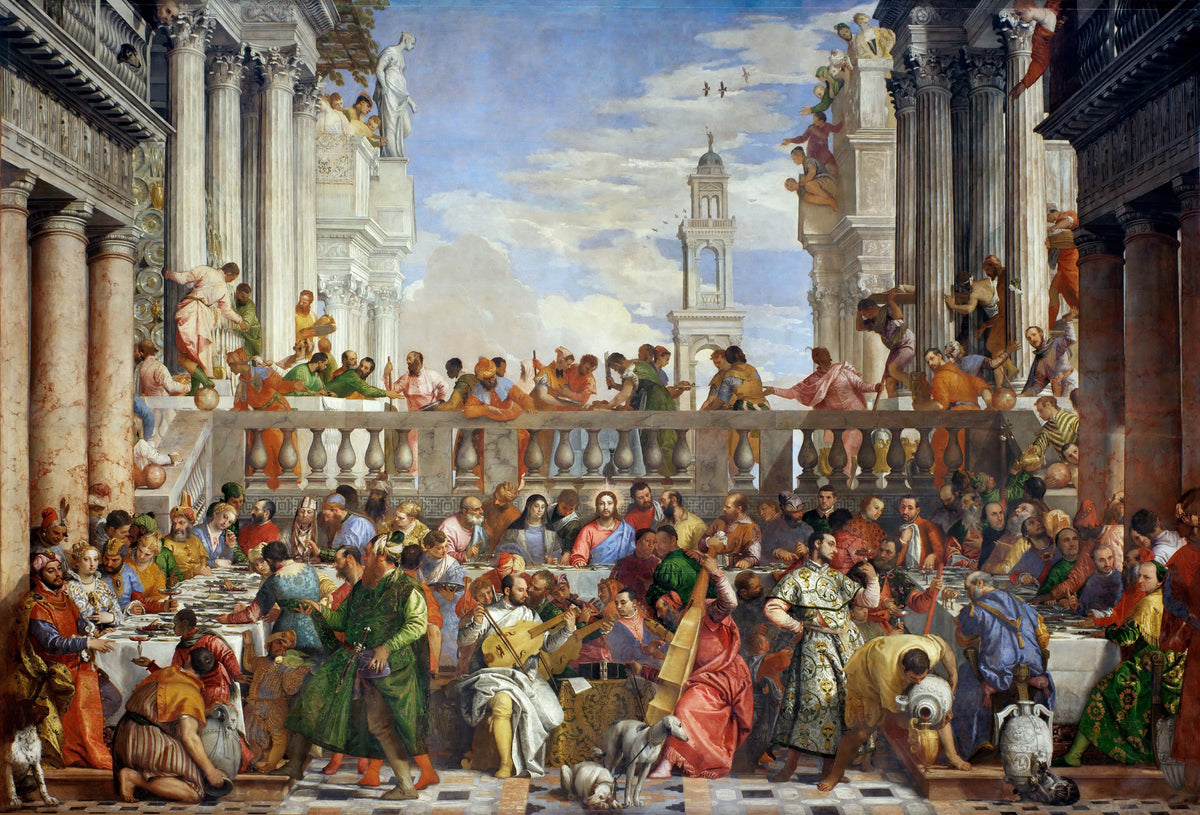
The Wedding at Cana, Paolo Veronese, 1563
This is the largest painting in the Louvre, close to seven metres tall and ten wide, and for over two centuries it hung nowhere near Paris at all. Veronese painted it for the refectory of the Benedictine monastery of San Giorgio Maggiore in Venice, where monks ate their meals facing it, a scene of Christ's first miracle staged as an enormous, contemporary Venetian banquet rather than a modest ancient one, over a hundred figures deep.
In 1797, Napoleon's soldiers, occupying Venice during the Italian campaign, cut the canvas down and rolled it around a cylinder to ship it back to France as war booty, a physically brutal way to move a work of this scale. It went first to Toulon, then Arles, then finally the Louvre. When France later returned a wave of looted Italian art after Napoleon's fall, this painting stayed behind, judged too large and too fragile to safely move again. A full-scale replica was eventually made and now hangs in the original refectory in Venice.
It hangs today in the Louvre's Salle des États, directly across from the Mona Lisa, the two most-viewed works in the museum facing each other across the same room.
Source: Musée du Louvre, Paris, INV 142.

